Today we looked at some examples of prints that students made in previous years and the etched plates that produced them. At this point you should all start planning your compositions by producing at least 4 thumbnail sketches.
Tuesday, 30 October 2012

Monday, 29 October 2012
Oct. 29 Class
Today we discussed a bit more about Greek art to give you some inspiration for your Neoclassical hero images. Keep in mind images of Greek pottery, sculpture and architecture.


You can also draw on Greek myths and legends such as the Greek gods and Olympians as inspirations of ways to depict your hero. Here are some steps that I will be looking for in your process:
Sketchbook Work:
At least 4 thumbnail sketches of composition (Formative).
Final plan completed in full size to be transferred to etching (Summative).


You can also draw on Greek myths and legends such as the Greek gods and Olympians as inspirations of ways to depict your hero. Here are some steps that I will be looking for in your process:
Sketchbook Work:
- Self portraits (3)
- Source images of Hero
- Source images of Greek/Roman Art
- Other support images if necessary
At least 4 thumbnail sketches of composition (Formative).
Final plan completed in full size to be transferred to etching (Summative).
Friday, 26 October 2012
Oct. 26 Class
Today we talked more about the Neoclassical period. To fully understand it we have to know a bit about the Rococo period that came before it. The Rococo was characterized by highly ornate and decorative art. Rococo paintings depicted love, romance and party scenes. Here are a few examples of the Rococo style.


This style was popular among the French nobility. However, during the French Revolution, the nobility was overthrown and a new form of art emerged in revolt of the Rococo style. This was the Neoclassical style led by David. His goal was to depict heroic scenes that would inspire the revolution. These images included the Death of Marat and the Oath of the Horatii that we discussed previously.
The Neoclassical style favoured order, calm and rationality. They preferred the use of bold lines instead of colour. Their subject matter consisted of stories from the ancient Greeks and Romans. They considered the Rococo party scenes to be frivolous.
Homework:


This style was popular among the French nobility. However, during the French Revolution, the nobility was overthrown and a new form of art emerged in revolt of the Rococo style. This was the Neoclassical style led by David. His goal was to depict heroic scenes that would inspire the revolution. These images included the Death of Marat and the Oath of the Horatii that we discussed previously.
The Neoclassical style favoured order, calm and rationality. They preferred the use of bold lines instead of colour. Their subject matter consisted of stories from the ancient Greeks and Romans. They considered the Rococo party scenes to be frivolous.
Homework:
- Complete the worksheet.
- Find source images for the hero of your choice.
- Find source images of Greek and Roman art.
Thursday, 25 October 2012
Oct. 25 Class
Today we continued working on your self portraits as practice for the upcoming hero project. You should draw yourself in a full face view, 3/4 view and a profile of a friend of yours.
Please also read P. 464 - 470, the section on Neoclassicism.
Please also read P. 464 - 470, the section on Neoclassicism.
Wednesday, 24 October 2012
Oct. 24 Class
Today we continued our discussion of heroism by sharing who each of us chose as our heroes. We found that the situation is not always clear cut. For example, David painted heroic images of Napoleon,


But some of you thought that Napolean was a tyrant who was responsible for many deaths and did not deserve to be seen as a hero. What did David do to make these portraits seem more heroic?
We also discussed one contemporary example of a controversial hero: Lance Armstrong. He won the Tour de France 7 times, which is one of the toughest cycling races in the world. He also beat cancer and used his fame to raise millions of dollars for cancer research. However, it recently came to light that he used steroids and essentially cheated to win all those titles. He was stripped of those titles and banned from professional cycling. Do you think he should still be seen as a hero? Do you find his deeds heroic?
We also took some time to discuss more of the work of David. We talked about Neoclassicism, a movement that was inspired by the art of the ancient Greeks and Romans. This intrest in the ancients was brought about by the discovery of Pompeii and Herculaneum, Roman cities that were buried under a volcano's eruption. Here are some examples of Neoclassical art, all by David.


In your hero portraits we will use such image of inspiration and try to incorporate Neoclassical ideas into our work.
We then began drawing some self portraits in our sketchbooks as practice.
Tuesday, 23 October 2012
Oct. 23 Class
Today we began our new unit by discussing what makes a hero? What are the characteristics of a person that makes them a hero?
Here are some images of people who might be held up as heroes throughout history:
We discussed the idea in groups and here are some of your responses:
Here are some images of people who might be held up as heroes throughout history:
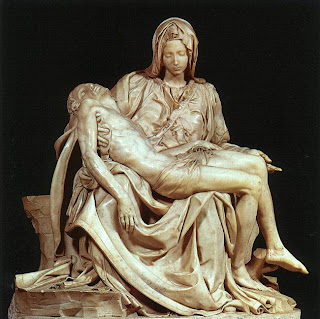 |
| Jesus Christ was the main hero in much of religious art, including this piece by Michelangelo called the Pieta. |

 |
| During the French Revolution, political figures were held up as heroes such as Jean-Paul Marat. This piece was painted by Jacques-Louis David to commemorate him. |
 |
| This is a depiction of a Chinese general named Guan Yu who was known for his loyalty and trustworthiness. He fought in many wars and eventually died at the hand of his enemies. |
.jpeg) |
| In modern times we have many great political leaders who are seen as heroes. Aung San Suu Kyi won an election in Burma, but the military refused to hand over power and held her under house arrest for over 15 years. She continues to fight for freedom and democracy in her country today. |
We discussed the idea in groups and here are some of your responses:
- A hero is someone who does something honourable.
- Someone who is selfless.
- Someone who does something admirable.
- Someone who is courageous.
- Someone who sacrifices themselves.
Some of you mentioned that heroes don't have to be famous and can make a difference to people's everyday lives on a smaller scale. Some of you mentioned your mothers were your heroes.
We then went to the library to find images of heroes that we can use as sources to inform our work in the coming weeks.
Thursday, 18 October 2012
Oct. 18 Class
Today was the absolute last day for working on the Pop-up paintings! We will be doing the critique tomorrow so be prepared. Don't forget your written statement to be handed in with your work.
Here is a copy of the rubric and marking scheme for artists statement.
Here is a copy of the rubric and marking scheme for artists statement.
Subscribe to:
Posts (Atom)